 BUF
BUF  TOR
TOR  NYI
NYI  OTT
OTT  SEA
SEA  TB
TB  VAN
VAN  FLA
FLA  NYR
NYR  NJ
NJ  PHI
PHI  DET
DET  WPG
WPG  CHI
CHI  SJ
SJ  NSH
NSH  STL
STL  MIN
MIN  UTA
UTA  EDM
EDM  CGY
CGY  VGK
VGK  SEA
SEA  DEN
DEN  TOR
TOR  NYK
NYK  OKC
OKC  HOU
HOU  PIT
PIT  COL
COL  BOS
BOS  ANA
ANA  MIA
MIA  ORL
ORL  BOS
BOS  PHI
PHI  DET
DET  MIL
MIL  IND
IND  ATL
ATL  DAL
DAL  SAC
SAC  SAS
SAS  CHA
CHA  MEM
MEM  WAS
WAS  NOP
NOP  MIN
MIN  CHI
CHI  POR
POR  GSW
GSW  UTA
UTA  PHX
PHX  DEN
DEN  LAL
LAL  WSH
WSH  CAR
CAR  MTL
MTL  CBJ
CBJ  DAL
DAL  LA
LA 

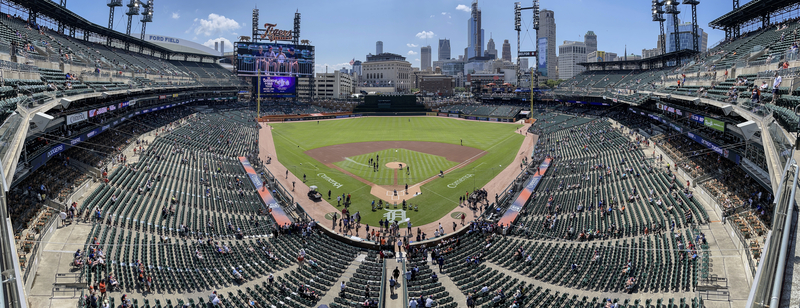
In a dramatic finish to the 2025-26 offseason, the Detroit Tigers made headlines by signing starting pitchers Framber Valdez and welcoming back future Hall of Famer Justin Verlander. This surge in activity has propelled the Tigers’ payroll to a franchise-record $203,747,859 for opening day, with a competitive balance tax (CBT) payroll projected at $242,091,505, according to Cot’s Contracts.
Last season, the Tigers began with a projected payroll of $145,318,033 and ultimately reached a CBT payroll of $186,627,318. This marked a significant increase, leaving the club about $55 million shy of the CBT threshold of $241 million for the 2025 season.
For the 2026 season, the lowest tier of the tax brackets is set at $244 million, putting the Tigers just $2 million away from incurring a luxury tax on any salaries exceeding that mark. However, the tax implications may not pose a concern for owner Chris Ilitch and the front office. Any tax incurred would only apply to the amount that surpasses the threshold. For instance, should the Tigers acquire a player at the trade deadline, pushing their payroll to $250 million, they would owe a tax of 20 percent on the $6 million overage, totaling $1.2 million—a manageable figure in the grand scheme.
Yet, crossing the CBT threshold does come with its own set of challenges. A team that pays luxury tax could face repercussions in the form of reduced revenue-sharing rebates the following season, alongside steeper penalties for signing free agents who had previously declined qualifying offers. The Tigers, for instance, will forfeit their third-highest draft choice due to signing Framber Valdez, who declined a qualifying offer from the Houston Astros. If they were to make similar moves as a CBT payor, the consequences would escalate, resulting in the loss of their second-highest draft choice and a $1 million deduction from international signing bonus funds.
As the collective bargaining agreement is set to expire on December 1, 2026, the landscape for next winter’s free agents remains uncertain. However, it’s likely that players receiving qualifying offers in November will fall under the current CBA’s terms.
Cot’s Contracts also provides a comprehensive breakdown of payroll, including estimates for injury replacements, player benefits, bonus pool contributions, and minor league salaries. However, these calculations do not factor in mid-season trades that could alter the payroll landscape.
The payroll outlook shifted in November when Jack Flaherty exercised a $20 million player option and Gleyber Torres accepted a $22.5 million qualifying offer, bringing the payroll back to previous levels without any new acquisitions. The Tigers also added Drew Anderson on a one-year, $7 million deal, while Tarik Skubal’s arbitration victory resulted in a $32 million salary for the 2026 season.
On the subtraction side, the Tigers retained most of their core players, with Alex Cobb’s $15 million contract, Kenta Maeda’s $10 million deal, and several others exiting the roster, saving the club a total of $37 million after accounting for Torres’ $15 million salary for 2025. The team has also re-signed part-time closer Kyle Finnegan for two years at an average annual value (AAV) of $9.5 million, alongside closer Kenley Jansen on a one-year deal worth $9 million, which includes an option for $12 million with a $2 million buyout.
The differences between major league payroll and CBT payroll are noteworthy. Player salaries for tax purposes are calculated using the average annual value (AAV), meaning Valdez’s salary will count as $36.523 million for CBT, despite him earning $22.826 million this season. Additionally, all players on the 40-man roster, including those on injured reserve, are included in the CBT payroll, which also accounts for about $18 million per season toward player benefits and $1.67 million for the pre-arbitration bonus pool.
Among the 40-man roster, minor league salaries account for less than $2.7 million, barring any players with guaranteed contracts who have been optioned. Cot’s Contracts estimates a typical number of major league players will be injured and replaced by others earning near the major league minimum salary of $790,000. The Tigers could find themselves in tax territory if they make mid-season moves that alter their payroll.
As the 2026 season approaches, the Tigers’ roster reveals that three players, Zack McKinstry, Jahmai Jones, and Drew Anderson, are out of options, giving them an advantage in securing roster spots. Additionally, ten players with five years of service time cannot be sent to the minors without their consent, including notable names like Javier Baez, Justin Verlander, and Gleyber Torres.
Looking ahead, the 2027 free agent class presents a significant challenge for the Tigers, with key players like Tarik Skubal, Casey Mize, and Jack Flaherty eligible for free agency unless contract extensions are secured. With only Javy Baez, Framber Valdez, Kyle Finnegan, and Colt Keith holding guaranteed contracts beyond 2026, the Tigers have considerable payroll flexibility as they work to reshape their starting rotation for the future.
Note: This recap is an independently written summary based on publicly available reporting.